Table of Contents
TogglePicture this. A B.Com graduate from Chennai registers with ACCA, opens the portal, and sees a notification: exemptions available. Four papers, gone. She clicks accept on all of them, pays the fee, and feels like she just skipped a semester.
Six months later she is sitting in Financial Reporting, staring at a consolidation question, realising she never actually learned the basics properly in college. She now has to relearn Financial Accounting on her own time, while paying for a paper she is struggling with.
The exemption saved her one exam. It cost her a lot more than that.
This is the part nobody talks about when they discuss ACCA exemptions in India. The rules are simple enough. What trips students up is the money, the deadlines, and the assumption that more exemptions automatically means a better deal.
What ACCA actually gives you
ACCA awards exemptions across the Foundation level qualifications and the nine Applied Knowledge and Applied Skills exams. That is the ceiling. There are no exemptions for the four Strategic Professional exams, and none awarded on the basis of work experience alone. So even a fully qualified Indian CA with all nine exemptions still writes four papers.
For Indian students, the usual pattern looks like this. A B.Com typically earns three to four exemptions. CA Inter can take you up to six. A qualified CA can reach the full nine. But this varies by university and by the year you graduated, because ACCA assesses each institution’s syllabus separately. Two students with the same degree from different colleges can genuinely get different results.
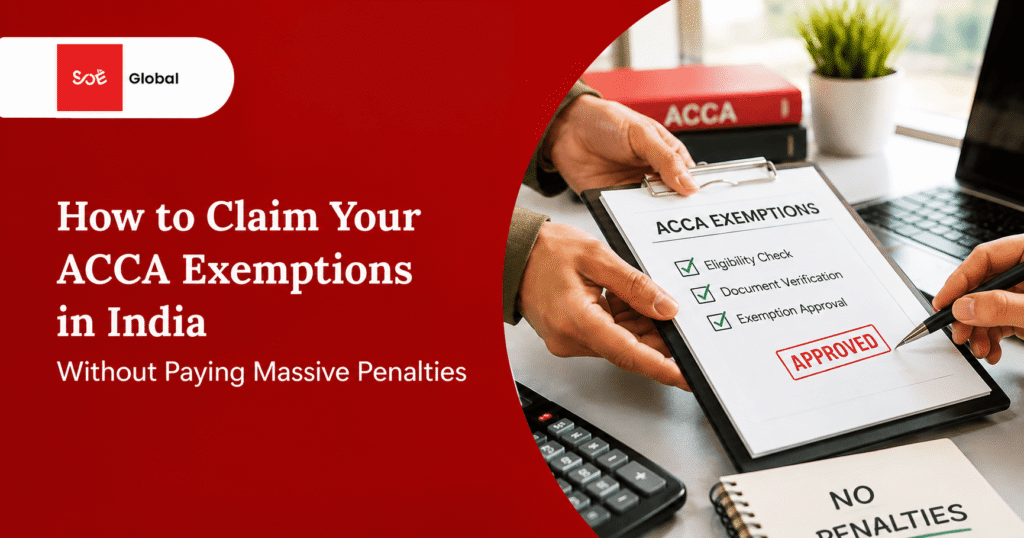
Start with the official exemption calculator on the ACCA website. It is free, takes about five minutes, and needs no login. Treat the result as indicative rather than final. Your real exemptions are confirmed only after ACCA reviews your transcripts.
The fees are the real story
Every exemption you claim carries a fee. As of 2026, that is £86 for each Applied Knowledge paper and £114 for each Applied Skills paper. Claim all nine and you are looking at £942, which at current exchange rates lands somewhere around a lakh in rupees before your bank adds its foreign transaction charge.
That is not a penalty. It is just the price. The penalties come from what happens next.
The 30 day payment window. Once exemptions are awarded to you, the fees must be paid within 30 days. Miss that and your account status is at risk.
The 14 day cancellation window. This is the one that quietly costs students the most. If you change your mind about an exemption, you have to tell ACCA within 14 days of it being awarded. After that, no refund, no credit. Fourteen days is not long when you are still deciding whether you actually remember cost accounting.
Falling off the register. Students who do not pay fees when due are removed from the ACCA register. Getting back on means paying an £89 re-registration fee plus all the unpaid amounts. The annual subscription itself is £140. A gap year that you did not plan for gets expensive fast.
Late exam entry. Not an exemption fee, but worth knowing because it is the single biggest jump in ACCA’s price list. An Applied Skills exam booked at standard entry costs £160. Book it during the late entry window and it becomes £409. Same exam, same paper, roughly two and a half times the cost, purely because of a missed date.
The order of operations that saves you money
Here is the sequence that actually works.
Run the exemption calculator before you register, not after. Keep your degree certificate, all mark sheets, and a valid ID scanned and ready in English. Any mismatch in name or year of study delays the review, and delays are what push you into late entry windows.
Apply for exemptions with your initial registration if you already hold the qualification. If you finish a degree later, you can apply at any point afterwards through the help section in myACCA.
When the exemptions are offered, read the claim screen carefully. There is a toggle next to each paper. They do not have to be claimed together. You can accept three now and come back for the fourth later, once you have decided.
Then pay within 30 days and keep the receipt.
Should you claim all of them?
ACCA’s own advice is more cautious than most coaching institutes will tell you. Exemptions make sense when the learning is recent and still fresh. If you are claiming on the strength of a degree you finished years ago, or you have been working outside accountancy since, ACCA suggests it may be more useful to sit the exam and rebuild the foundation properly.
There is a free way to test this. The Get Ready Modules let you check your underlying knowledge in each subject. If you find real gaps, forfeit that exemption and write the paper instead. You will pay an exam fee rather than an exemption fee, and you will walk into Strategic Professional with the basics intact.
One warning that deserves stating plainly. If an exemption application is found to be based on false documents, ACCA can treat your student registration as void and remove you from the register, with no refund of registration or exemption fees. Do not let an agent or consultant submit anything on your behalf that you have not personally verified.
The short version
Check the calculator first. Claim selectively rather than automatically. Pay within 30 days. Decide within 14. Book exams at standard entry. Keep your subscription current.
Do those six things and your ACCA exemptions in India will do exactly what they are meant to do, which is start you at the right level rather than the earliest one.
FAQs related to How to Claim Your ACCA Exemptions in India
How many ACCA exemptions can I get?
Up to nine, across Applied Knowledge and Applied Skills only.
Do CAs get exemptions from Strategic Professional?
No. Nobody does. All four papers must be written.
What does each exemption cost?
£86 per Applied Knowledge paper, £114 per Applied Skills paper (2026 rates).
How long do I have to pay?
30 days from the date the exemptions are awarded.
Can I cancel an exemption after claiming it?
Only within 14 days of the award. After that, no refund or credit.
Do I have to claim all offered exemptions?
No. Each one has its own toggle. Claim some now, the rest later.
How many exemptions does a B.Com get?
Usually three to four, but it depends on your university and graduation year.
Can I apply for exemptions after registering?
Yes, at any time, through the help section in myACCA.
What happens if I stop paying my subscription?
You’re removed from the register. Returning costs £89 plus all unpaid fees.
Are exemptions granted for work experience?
No. Only for prior qualifications ACCA has assessed.