Table of Contents
ToggleACCA (Association of Chartered Accountants) could be for you if you dream of a career in finance where you are a numbers guru! Before you dive in, let’s talk about what you need.All about the ACCA course eligibility and its requirements are jotted down for you below!
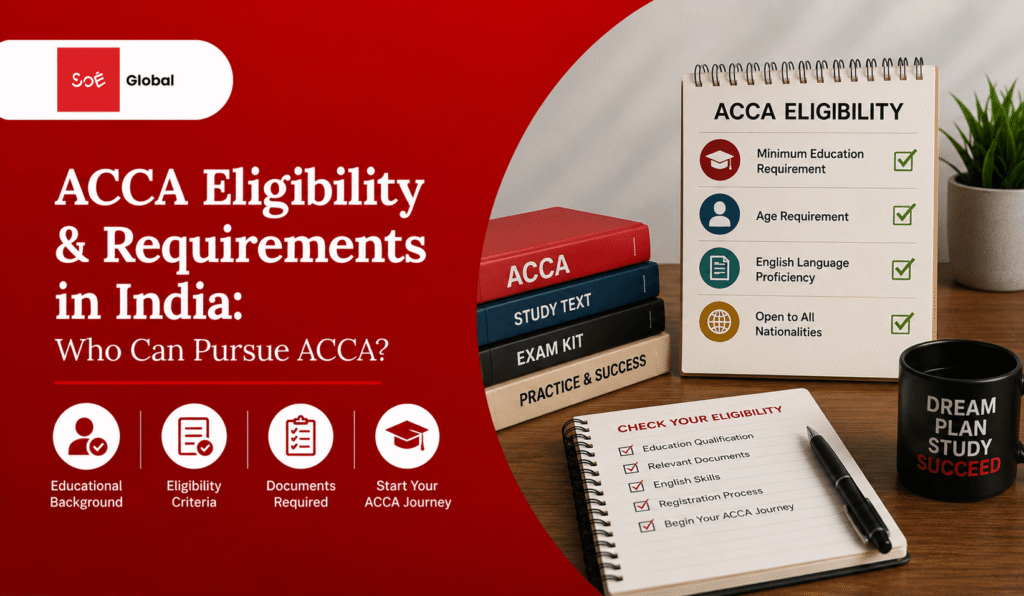
ACCA Eligibility:
ACCA serves individuals at various career stages. The ACCA course qualification is suitable for recent graduates entering the accountancy and finance sector, it is equally valuable for mid-career professionals looking to update their skills or change careers.
1. Minimum 10+2 (or equivalent)
Minimum requirements are class 10+12 qualification and minimum age 17 years. There is no specific subject you should go for, but accounting basics can be helpful.
Good grades (bonus!): Even if the minimum grades are enough, aiming for higher scores can help you get scholarships.
Exemptions: Prior education and qualifications that provide experienced professionals with exemptions from certain tests.
- Holders of Business Degrees (BMS, BBA & BBM) receive 1 exemption in BT, MA, or FA.
- Commerce Degree holders (BCom, BAF, BBI) are eligible for 5 exemptions in BT, MA, FA, LW, and TX.
- This will allow them to accelerate their ACCA journey and focus on areas that need further development. TX and AA.
- Those who are approved by IPCC get 6 exemptions for BT, MA, FA, LW, TX and AA.
- Accountants with activated CA get 9 exemptions for BT, MA, FA, LW, PM, TX , for FR , AA and FM.
Remember: The SOE Global website maintains a database where you can check for possible exemptions based on specific qualifications.
2. Commitment and a growth mindset:
While qualifications are important, the ACCA journey also requires commitment and a growth mindset. It requires commitment, persistence and a willingness to learn and adapt. Here are some more features that will come in handy for you.
Passion for numbers and business: If the thought of analysing financial statements and spreadsheets excites you, you are on the right track!
Problem solving skills: The ACCA course will get you thinking. critically and design solutions to complex accounting issues relevant to the Indian context.
Strong work ethic: Be prepared to make the necessary effort to study, practice and master Indian accounting standards and regulations.
Climbing the Ladder: Three Levels of the ACCA Course
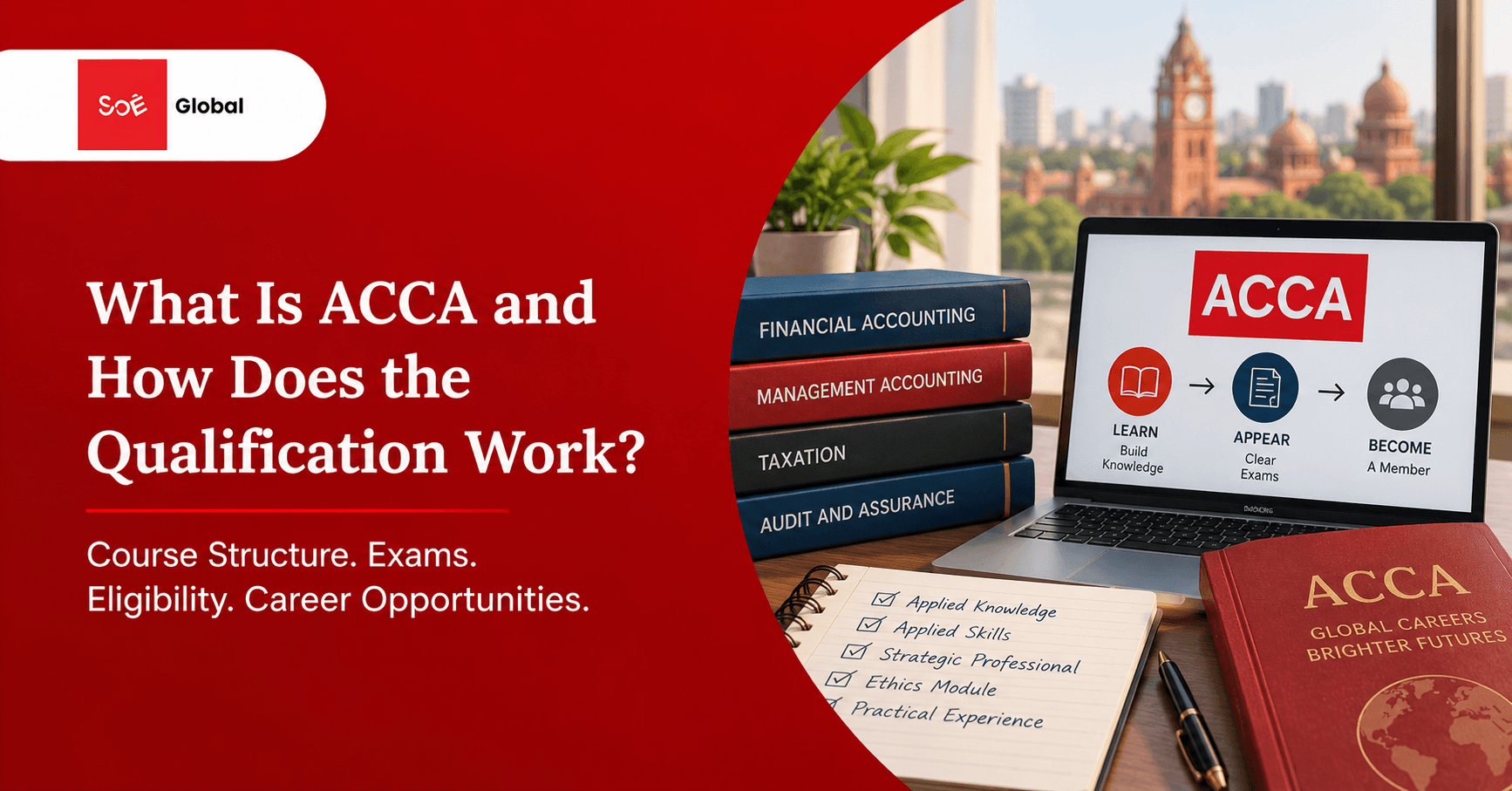
The ACCA -program is divided into three levels, each of which changes successively more complex and designed to give you a comprehensive understanding of accounting principles. Here’s a breakdown of what to expect:
Applied Knowledge Level: This introductory stage focuses on building fundamental knowledge in areas such as financial accounting, management accounting and business ethics, all with a focus on Indian accounting practices. Here you will learn the alphabet of accounting.
Application Skill Level: Here you will deepen the practical applications of accounting in the Indian market. You will cover topics such as corporate law, Goods and Services Tax (GST) and performance management. Think of it as learning how to prepare complex financial statements that comply with Indian regulations.
Strategic Professional Level: This is where you become a true master of accounting. Advanced exams await you in areas such as financial management, performance management and taxation. Everyone is focused on the economic life of India. Be prepared to think strategically and solve complex accounting problems relevant to Indian companies – essentially become a financial problem-solving ninja!
Experience is essential: Practical Experience Requirement (PER)
The ACCA degree is not just about theory. To become a fully qualified member, you must complete three years of equivalent work experience in India under the supervision of a qualified accountant. This is known as a PER (Practical Experience Condition). Think of it as your internship in the vibrant world of accounting in India!
During this time, you will likely be required to perform various roles in areas such as financial reporting, auditing or taxation, all following Indian accounting standards. This hands-on experience will not only strengthen your understanding of accounting, but also help you find your niche in the Indian accounting and finance industry.
Lifelong Learning: The Power of Continuous Professional Development (CPD)
The world of accounting is constantly evolving and staying abreast of Indian regulations and best practices is key to success.The key This is where continuing professional development (CPD) comes into play. Imagine attending great accountancy workshops and conferences specifically focused on the Indian market.
Through CPD activities such as attending seminars, webinars or online courses offered by ACCA or Indian accountancy bodies, you can keep up to date with industry trends, regulations and best practices. This will not only help you maintain your professional reputation, it will also demonstrate your commitment to lifelong learning, which employers everywhere value
Conclusion: Your Path to Success at ACCA India
With a strong foundation, dedication and an ACCA degree, you will be. well equipped for Indian accounting and the exciting and dynamic world of finance for navigation. So take the first step towards your dream career – check the eligibility criteria and start your ACCA journey today!
FAQ’s Related To ACCA Course Eligibility & Requirements
Who is eligible for ACCA?
Minimum 10+2 qualification with a minimum age of 17 years.
What are the exemptions based on prior qualifications?
Exemptions are available based on degrees like Business, Commerce, IPCC, and CA.
What skills are necessary for ACCA?
Passion for numbers, problem-solving skills, and a strong work ethic.
How many levels are there in ACCA?
Three levels: Applied Knowledge, Application Skill, and Strategic Professional.
What is PER in ACCA?
Practical Experience Requirement – three years of equivalent work experience.
Why is CPD important in ACCA?
To stay updated with industry trends and regulations for professional development.
How can I check for exemptions?
Check the SOE Global website database for specific qualifications.
What does ACCA focus on in the Indian context?
Learning Indian accounting practices and regulations.
What is the minimum age requirement for ACCA?
Age: 17 years old.
How can I start my ACCA journey?
Check eligibility criteria and enroll in the program.