Table of Contents
ToggleAsk any accountant who’s been in the game for a decade, and they’ll tell you the job doesn’t look anything like it used to. Less time, punching numbers straight into spreadsheets, and way more time spent trying to figure out what those numbers actually are saying. That kind of shift is basically what ACCA is responding to with its 2027 update , and the redesign they’re calling Accountancy Redefined.
So, what’s really going on here really? And, even more importantly, what future skills is the new ACCA Qualification trying to build into you? Let’s go through it together, in plain English.
Why ACCA decided to change things
Finance isn’t slowing down. AI, automation, cloud tools and big data are quietly taking over the routine, repetitive parts of accounting the data entry, the reconciliations, the box-ticking. Machines are genuinely good at that stuff.
What machines can’t do is judgement. They can’t sit across from a client and advise on a tricky decision, weigh up the ethics of a grey area, or explain what a sustainability report actually means for a company’s bottom line. That’s where accountants are heading from record-keepers to trusted advisors.
ACCA looked at all of this and decided the qualification needed to catch up. The first exams under the new structure land in 2027, and the whole point is to future-proof your career for the world of finance that’s already arriving.
The future skills ACCA is building
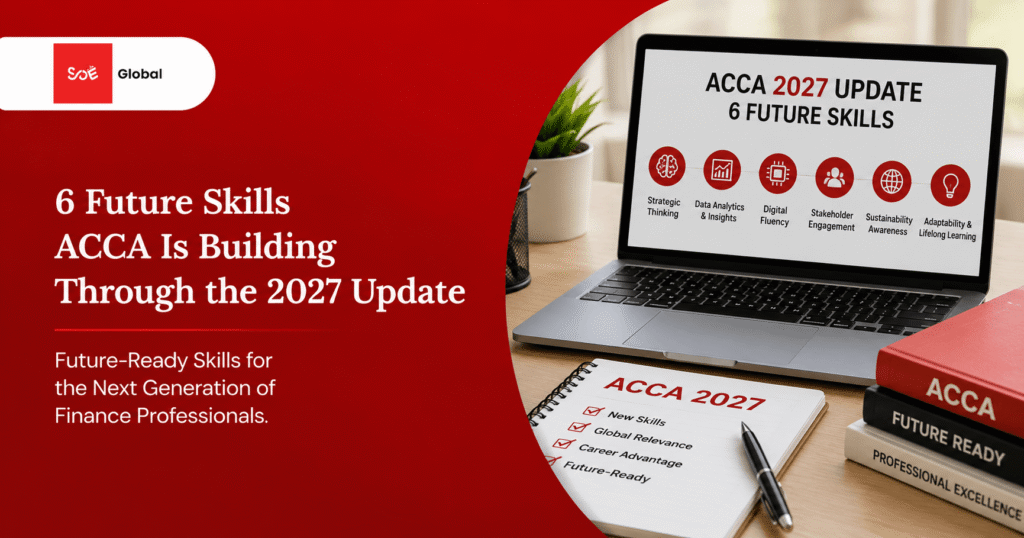
Here’s where it gets kind of interesting. The ACCA syllabus 2027 update isn’t just moving documents around, it’s deliberately constructing a particular set of future-ready capabilities, so it’s not random.
1. Digital and tech fluency
This is the big one. Technology, AI and innovation now run right through the syllabus instead of sitting in a corner. There’s a dedicated Digital Tech and Innovation employability module at the Expertise level, and a brand new Data Science Professional option at the top. The idea is simple: you shouldn’t just use finance tools, you should understand what’s happening under the hood.
2. Data-driven decision making
Numbers are easy to find these days. Making sense of them is the hard part. The new syllabus leans heavily into data, you’ll see it as early as Decision Making with Data at Foundations, right up to Performance with Data Analysis at Expertise level. The message is kind of clear, spreadsheets are the starting line not the finish.
3. Sustainability and ESG awareness
Sustainability isn’t some buzzword in the 2027 update,it’s already baked in. It’s basically part of the core exam, Business and Sustainability Reporting, and that sits at the Strategic Professional level, then paired up with an Ethical, Sustainable Leadership module. Employers are looking more and more for accountants who can actually read ESG disclosures, not just skim them, and who get how those statements connect to real-world impact. ACCA is doing the part to make sure you’re able to do that.
4. Real employability and workplace readiness
One of the biggest additions is the set of Essential Employability Modules (EEMs) running through every level. These aren’t dusty theories, they’re interactive, assessed modules covering business fundamentals, entrepreneurship, ethics, communication and technology. Some Optional Employability Modules can even count towards part of your practical experience down the line. In short, you leave more job-ready than before.
5. Ethics and leadership (still at the heart)
Here’s the reassuring bit for anyone worried ACCA is just chasing trends. Ethics hasn’t moved an inch; it’s still right at the centre of everything. What’s changed is the added emphasis on leadership and sound professional judgement: the human skills that make you genuinely hard to replace.
6. Flexibility to specialise
The new Strategic Professional level gives you Options exams Audit, Corporate Finance, Data Science, Performance and Insights, or Taxation Advisory. You get to lean into what actually interests you and shape a career path, instead of following one fixed track.
What this all means for you
If you’re already studying, breathe easy. Your completed exams still count, and there’s a transition tool to show you exactly where you land. Nobody’s asking you to start over.
If you’re just beginning or weighing up ACCA against other options this update honestly strengthens the case. The ACCA scope in the future looks broader not narrower, and that part is true whether you’re looking at a role in London, Dubai, or the fast growing ACCA future in India. A qualification that teaches AI awareness, data abilities, sustainability , and ethics all at once is kind of a solid head start.
The one thing worth doing? Don’t wait passively for 2027. Start building a tech skill now, even something like Excel or Power BI, and pick a study approach that links the theory to real-world practice. I mean, not just read it, try it, right? A coaching partner that connects the syllabus to those workplace scenarios, the actual messy ones, can make a noticeable difference in the end.The students who grow with these changes rather than against them are the ones who’ll come out ahead.
Because that’s the whole idea behind the 2027 update. Not to make accountants obsolete but to make sure the next generation of them is exactly the kind of professional the future of finance is crying out for.
FAQs Related To Future Skills ACCA Is Building Through the 2027 Update
What is the ACCA 2027 update?
It’s a redesign of the ACCA Qualification called Accountancy Redefined. The first exams under the new structure begin in 2027.
Why is ACCA changing its qualification?
To keep pace with AI, automation and changing finance roles. The goal is to future-proof the qualification and its members.
What future skills is ACCA focusing on?
Digital and AI fluency, data analytics, sustainability, employability and leadership — all woven through the syllabus alongside ethics.
What are Essential Employability Modules (EEMs)?
Interactive, assessed modules at every level covering business, tech, ethics and career skills. They’re built to make you job-ready.
Is there a new data-focused exam?
Yes. A new Data Science Professional option joins the Strategic Professional level, reflecting ACCA’s push towards tech and analytics.
How is the new ACCA structure organised?
Three levels — Knowledge, Expertise and Strategic Professional — with a Foundations route for those who need it first.
Does ethics still matter in the new syllabus?
Absolutely. Ethics remains right at the heart of the qualification, now paired with a stronger focus on leadership.
Will my completed ACCA exams still count?
Yes. Passed exams stay recognised, and ACCA’s transition tool shows how they map to the new structure. No resits needed.
How does the update handle sustainability?
It’s built in, including a core Business and Sustainability Reporting exam and an Ethical, Sustainable Leadership module.
Is ACCA still worth it after 2027 in India?
Very much so. The broader, tech-focused syllabus strengthens the ACCA scope in future, both in India and globally.
When do the first 2027 exams take place?
The new exams roll out from 2027, with the employability modules becoming available slightly earlier in the year.
What can I do now to prepare?
Start learning one tech skill, read up on the new modules, and choose a study path that connects concepts to real-world work.