Table of Contents
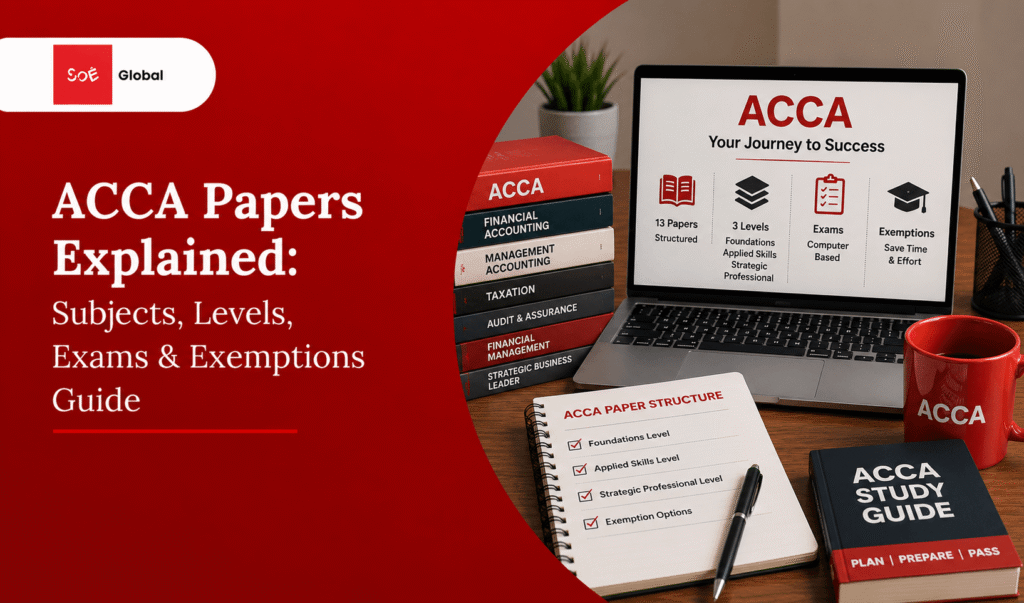
ToggleIf you are wondering how many papers ACCA has, the short answer is 13. These 13 subjects are spread across three progressive levels, and you work through them in a fixed order from foundation to advanced. That said, simply knowing the number does not help you plan. What most students actually need to know is what each subject covers, which ones are genuinely difficult, how the exams are structured, and whether they can skip any papers based on what they have already studied.
This guide covers all of that in plain language. You will find the complete ACCA papers list with pass rates, a straight-talking breakdown of every subject, guidance on choosing your optional papers, and a clear exemptions table for Indian students who hold CA, CMA, CS or commerce degrees.
One important update before we start: ACCA has announced a qualification redesign coming into effect from September 2027, which will reduce the papers from 13 to 11. If you are starting or currently studying for ACCA, the current 13-paper structure applies fully to you. We will cover that change briefly at the end.
| Quick Answer: How many papers does ACCA have?ACCA has 13 exam papers in total, divided across three levels. Applied Knowledge has 3 papers (on-demand exams you can sit any time). Applied Skills has 6 papers (sat at fixed sittings in March, June, September and December). Strategic Professional has 4 papers — 2 compulsory and 2 chosen from 4 specialist options. You can sit up to 8 papers per year. To become fully qualified, you also need to complete the Ethics and Professional Skills Module and 3 years of practical work experience. |
Why ACCA Matters: A Few Numbers Worth Knowing
Before diving into the papers themselves, some context helps explain why so many students in India and worldwide are choosing this qualification.
257,900+ fully qualified ACCA members globally, with 530,100 students currently working towards the qualification across 180 countries. (Source: ACCA Global, December 2025)
252,500+ students sat ACCA exams in the December 2025 session alone, making it one of the largest professional accountancy exam sittings anywhere in the world.
CA Final holders can skip up to 9 of the 13 ACCA papers through exemptions, making the path to ACCA membership significantly shorter for qualified Indian chartered accountants.
| “The ACCA Qualification has always been the gold standard, globally recognised and highly valued by employers. It will remain as rigorous, relevant and future-focused as ever, with an even sharper focus on employability.”— Alan Hatfield, Executive Director of Content, Quality and Innovation, ACCA Global |
How Is the ACCA Course Structured?
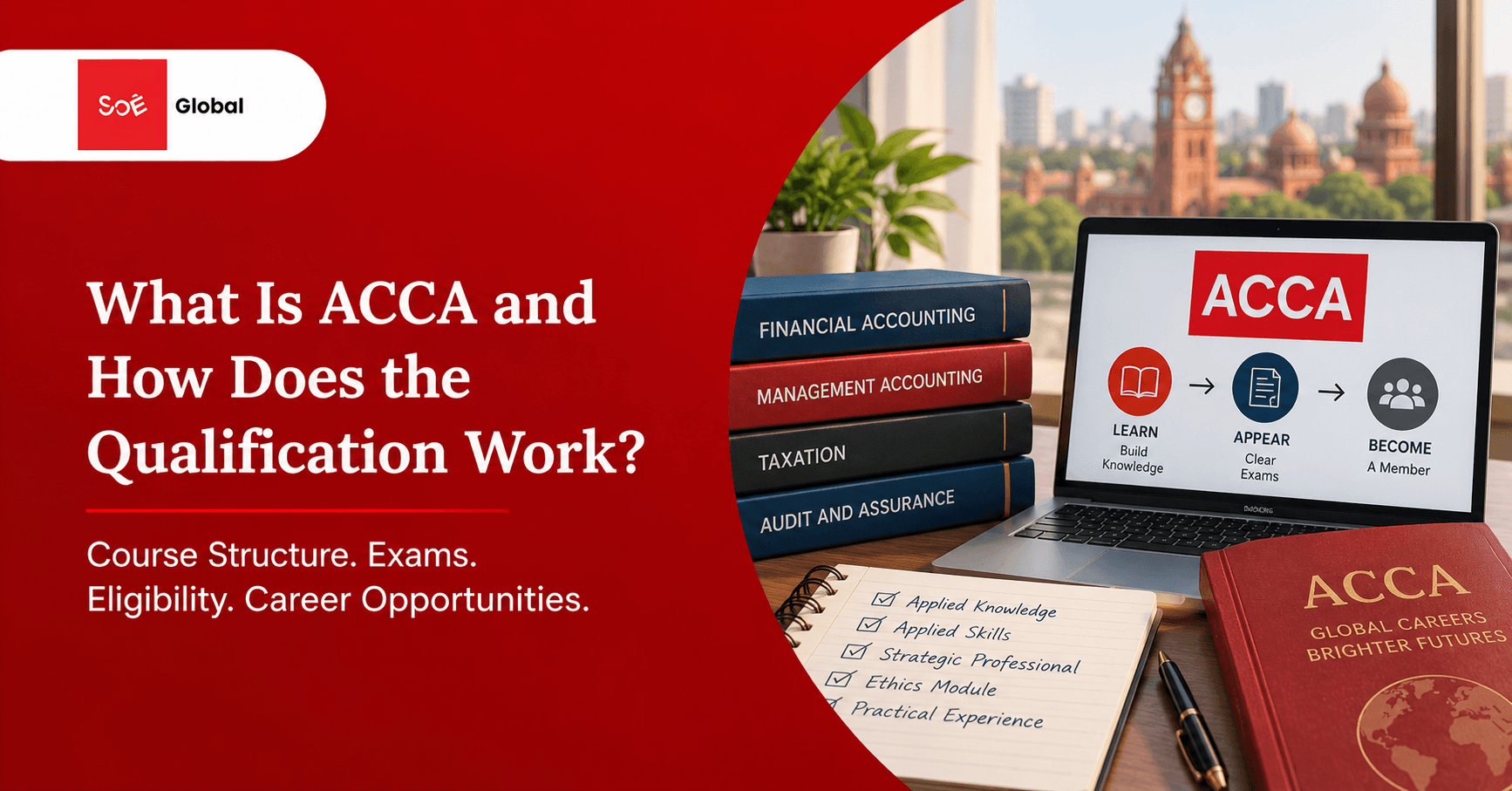
The ACCA course follows a three-level structure. Each level builds directly on the one before it, which is why you cannot jump ahead. Think of it as a staircase where each step assumes you have already climbed the ones below it.
Level 1: Applied Knowledge (3 subjects)
This is where everyone starts. The three Applied Knowledge subjects — also called ACCA foundation level exams — introduce the fundamentals of business, management accounting and financial accounting. What makes this level different from the others is that the exams are on-demand. You can sit them any time of year at a Pearson VUE test centre, so there is no waiting for the next exam window. Most students clear all three within six months.
Level 2: Applied Skills (6 subjects)
This is where the real work begins. The six Applied Skills subjects are substantially harder than Applied Knowledge, and the pass rates drop noticeably as a result. These papers are sat at four fixed sittings per year and cover law, taxation, performance management, financial reporting, audit and financial management. You need to have passed all Applied Knowledge papers before attempting these.
Level 3: Strategic Professional (4 subjects)
The Strategic Professional level is what separates an ACCA qualified professional from someone who is simply part-qualified. You must pass two compulsory papers (Strategic Business Leader and Strategic Business Reporting) and two papers from a choice of four specialist options. This is where you start thinking about which area of finance you want to specialise in. No exemptions are available at this level regardless of your prior qualification.
Ethics and Professional Skills Module
This is a mandatory online module that you complete after finishing your Applied Knowledge papers. It takes roughly 40 hours and is entirely self-paced. It does not count as one of the 13 exam papers, but you cannot become an ACCA affiliate without completing it.
Practical Experience Requirements (PER)
Alongside all of the above, you need three years of relevant work experience. This runs concurrently with your studies and is logged through your myACCA account. You do not need to complete your exams before starting to log experience.
| Part-Qualified Status in ACCAHow many ACCA exams do you need to be part-qualified? ACCA recognises part-qualified status once you have passed all three Applied Knowledge papers plus at least one Applied Skills paper. At this stage, you are eligible to use the term ‘ACCA student’ professionally in most contexts and can reference your part-qualified status when applying for finance roles. |
The Complete ACCA Papers List (2025)
The table below covers all 13 ACCA subjects, their codes, what each one covers, the latest pass rates from ACCA Global and the exam format. Pass rates marked with an asterisk are based on December 2025 session data published by ACCA Global in January 2026.
| Level | Paper | Code | What It Covers | Pass Rate* | Exam Format |
|---|---|---|---|---|---|
| Applied Knowledge | Business and Technology | BT | How organisations work, governance, digital tech in accounting, leadership, ethics and internal controls | 83% | On-demand CBE, 2 hrs, 100 MCQs |
| Management Accounting | MA | Cost behaviour, budgeting, variance analysis, marginal costing, short-term decision making | 77% | On-demand CBE, 2 hrs, 100 MCQs | |
| Financial Accounting | FA | Double-entry bookkeeping, IASB framework, financial statements, basic group accounts under IFRS | 73% | On-demand CBE, 2 hrs, 100 MCQs | |
| Applied Skills | Corporate and Business Law | LW | Contract law, company law, employment law, corporate governance — Global (English) variant for Indian students | 76% | CBE, 3 hrs 15 mins, Section A + B |
| Performance Management | PM | Activity-based costing, transfer pricing, balanced scorecard, budgeting beyond the basics | 40% | CBE, 3 hrs 15 mins, Section A + B | |
| Taxation | TX | Income tax, corporate tax, capital gains, VAT, inheritance tax — UK variant for most Indian students | 52% | CBE, 3 hrs 15 mins, Section A + B | |
| Financial Reporting | FR | IFRS in depth, consolidated accounts (subsidiaries, associates, JVs), statement of cash flows, ratio analysis | 49% | CBE, 3 hrs 15 mins, Section A + B | |
| Audit and Assurance | AA | Audit risk, internal controls, evidence gathering, audit reports, going concern, ethics for auditors | 43% | CBE, 3 hrs 15 mins, Section A + B | |
| Financial Management | FM | NPV, IRR, WACC, CAPM, working capital, business valuation, hedging interest rate and FX risk | 52% | CBE, 3 hrs 15 mins, Section A + B | |
| Strategic Professional (Compulsory) | Strategic Business Leader | SBL | 4-hour integrated case study: strategy, governance, risk, ethics, leadership, digital transformation | 50% | CBE, 4 hrs, integrated case study |
| Strategic Business Reporting | SBR | Advanced IFRS, complex group accounts, financial instruments, pensions, sustainability reporting | 48% | CBE, 3 hrs 15 mins, Section A + B | |
| Strategic Professional (Choose 2 of 4) | Advanced Financial Management | AFM | M&A valuation, real options, treasury management, international finance, advanced investment appraisal | 34% | CBE, 3 hrs 15 mins, Section A + B |
| Advanced Performance Management | APM | Strategic performance systems, environmental reporting, divisional KPIs, current global issues | 31% | CBE, 3 hrs 15 mins, Section A + B | |
| Advanced Taxation | ATX | Complex tax planning, international tax, trusts, anti-avoidance, stamp taxes, ethical issues in tax | 41% | CBE, 3 hrs 15 mins, Section A + B | |
| Advanced Audit and Assurance | AAA | Group audits, forensic accounting, due diligence, audit quality, current auditing standards | 38% | CBE, 3 hrs 15 mins, Section A + B |
*Pass rates sourced from ACCA Global official December 2025 exam results. Green = pass rate above 65%. Amber = 40 to 65%. Red = below 40%.
Every ACCA Subject Explained
Here is a plain-language breakdown of what each of the 13 ACCA papers actually covers, along with an honest note on what catches students out.
Applied Knowledge: The Three Foundation Papers
BT — Business and Technology
BT is the starting point of your ACCA journey. It covers how organisations are structured and run, how technology and digital systems fit into modern accounting, corporate governance basics and professional ethics. The exam is fully objective-based multiple-choice. With a pass rate of around 83%, this is the most accessible paper in the qualification, but do not ignore it at your peril. The ethics content here lays the groundwork for topics that come back much harder in Strategic Professional.
MA — Management Accounting
MA introduces the internal side of accounting: how businesses track costs, prepare budgets and make short-term financial decisions. If you studied cost accounting in B.Com or CA Inter, much of this will feel familiar. The exam is 100 MCQs and includes numerical data-entry questions, so practice in the CBE environment matters alongside content knowledge.
FA — Financial Accounting (the ACCA Applied Knowledge financial accounting paper)
FA teaches you how to prepare financial statements under the IASB Conceptual Framework and key IFRS standards. Double-entry bookkeeping, the accounting equation, ledger accounts, trial balance, income statement, balance sheet and a basic introduction to group accounts. For CA Inter students, this paper has significant overlap with their existing knowledge. The main thing to adjust for is the shift from Indian GAAP to IFRS treatment on certain items.
Applied Skills: Where the Difficulty Jumps
The Applied Skills level is where most students invest the heaviest study time. Pass rates across these six papers range from 40% to 76%, and the exam format shifts from pure MCQs to longer scenario-based questions that require you to analyse and write, not just tick boxes. The recommended sequence is to start with LW and FM, then move to PM and TX, then FR and AA.
LW — Corporate and Business Law
LW is available in a Global (English) variant, which is what most Indian students sit. It covers the legal frameworks that accountants work within: contract law, company law, employment law and corporate governance. The content is more text-heavy than the other Applied Skills papers. The key is understanding how to apply legal principles to scenarios rather than memorising definitions.
PM — Performance Management
PM is where management accounting gets genuinely difficult. You move from the basics of MA into activity-based costing, transfer pricing, the balanced scorecard, environmental management accounting and advanced budgeting techniques. The 40% pass rate reflects how many students underestimate the shift in exam style. Questions in PM ask you to evaluate and recommend, not just calculate.
TX — Taxation
Most Indian students sit the TX-UK variant since India does not currently have its own ACCA tax variant. TX covers income tax, corporate tax, capital gains tax, VAT and inheritance tax as they apply in the UK tax system. One important practical note: tax law changes with each Finance Act, so always use study materials tied to the specific exam session you are sitting.
FR — Financial Reporting
FR is where IFRS really takes hold. You go from the basic financial statements in FA to preparing complex consolidated group accounts, applying IAS and IFRS standards in depth and interpreting financial statements for analysis. The consolidation question in Section B is typically worth 25 marks and is where many students lose the exam. Practise group accounts until they become second nature.
AA — Audit and Assurance
AA introduces the theory and methodology of external auditing. You study audit risk, how to evaluate internal controls, what audit evidence is required and how to write audit reports. The paper is less calculation-heavy than most others, but it demands clear, structured written answers. The ethical framework for auditors introduced here also connects directly to AAA if you choose that optional paper later.
FM — Financial Management
FM is the most quantitative paper in the Applied Skills level. You cover investment appraisal using NPV and IRR, the cost of capital using WACC and CAPM, working capital management, business valuation and hedging strategies for interest rate and foreign exchange risk. Speed and accuracy with calculations matter here. Section A is 50% MCQs, many of which are numerical.
Strategic Professional: The Advanced Level
The Strategic Professional level changes the nature of the questions entirely. You are no longer being asked to demonstrate technical knowledge in isolation. You are being asked to act like a senior finance professional: advising, evaluating, justifying decisions and working with incomplete information under time pressure.
SBL — Strategic Business Leader (Compulsory)
SBL replaced the old P1 and P3 papers and is unlike any other exam in the qualification. It is a single four-hour case study based on a pre-released company scenario. You receive the case materials in advance and the exam asks you to respond as a senior advisor, covering strategy, governance, risk, ethics, technology and people management. Up to 20 of the 100 marks are awarded for professional skills: how you structure and communicate your answer, not just what you say.
SBR — Strategic Business Reporting (Compulsory)
SBR takes your IFRS knowledge from FR and pushes it to a professional level. Complex group structures, foreign currency translation, financial instruments under IFRS 9, share-based payments, pensions and current developments in sustainability reporting are all fair game. The ACCA examiner publishes technical articles before each sitting. Reading these is not optional. They directly shape the exam questions.
AFM — Advanced Financial Management (Optional)
AFM extends FM into the territory of corporate finance strategy. Mergers and acquisitions, advanced business valuation using real options, treasury management, international financial management and complex hedging structures. This is the most mathematically demanding of the four optional papers. It suits students heading towards investment banking, corporate treasury or CFO roles.
APM — Advanced Performance Management (Optional)
APM is about designing and evaluating performance systems at board level — not just calculating variances but questioning whether the right measures are being used in the first place. It covers non-financial performance, environmental and social reporting, the impact of technology on performance management, and how global economic developments affect strategy. It pairs well with consulting or management accounting career paths.
ATX — Advanced Taxation (Optional)
ATX goes well beyond TX into complex tax planning scenarios, trusts, the international dimension of taxation including double tax treaties, anti-avoidance legislation, stamp taxes and the ethical responsibilities of a tax adviser. If you are heading into Big 4 tax practice or tax advisory work, ATX combined with SBR is the natural pairing.
AAA — Advanced Audit and Assurance (Optional)
AAA has the lowest pass rate of any Strategic Professional paper at 38% in December 2025. It covers group audits, forensic accounting engagements, due diligence, quality management in audit firms and current developments in auditing standards and regulation. This is the right choice for anyone pursuing a career in external audit, but it demands exceptional written communication skills alongside the technical knowledge.
Which Two Optional Papers Should You Choose?
This is genuinely one of the most important decisions you make in the ACCA journey, and it is worth spending real time on rather than just picking the two with the highest pass rates. The optional papers you choose will signal to employers which area of finance you specialise in.
Choose AFM and APM if you want to work in corporate finance, financial planning and analysis, or senior management accounting roles in industry.
Choose ATX and AAA if you are building a career in public practice, particularly audit or tax advisory in a firm environment. This combination mirrors what Indian CA firms value.
Choose AFM and ATX if you are moving into investment banking, private equity or a role where both deal valuation and tax structuring matter.
Choose APM and ATX if you are targeting consulting or business advisory where performance strategy and tax efficiency are both relevant to your clients.
One practical note for Indian students: most Big 4 firms in India recruiting ACCA-qualified staff look favourably on either the ATX or AAA combination because it aligns with the audit and tax work that makes up a large portion of their service lines. If you are in Chennai working in or aiming for a Big 4 role, that is worth factoring into your choice.
ACCA Exam Structure and Exam Pattern
Understanding the ACCA exam structure helps you plan which papers to sit together and how much time each level needs. All ACCA exams are computer-based (CBE) and taken at Pearson VUE test centres. Paper-based exams are no longer available for any of the 13 standard papers.
ACCA Applied Knowledge Exam Pattern
The ACCA exam pattern at Applied Knowledge level is straightforward. Three on-demand exams, each two hours long and made up of 100 objective test questions. These include standard MCQs, multiple response, drag-and-drop and number-entry formats. You sit these whenever you are ready, with no fixed sitting dates. Pass mark is 50%.
ACCA Applied Skills Exam Pattern
Six papers sat at fixed sittings in March, June, September and December. Each exam is three hours and 15 minutes. Section A contains shorter objective test questions worth around 30 to 35 marks. Section B contains longer scenario-based questions requiring written analysis and calculations, worth the remaining 65 to 70 marks. You can sit up to four papers per sitting and up to eight per year. Pass mark is 50%.
ACCA Strategic Professional Exam Pattern
Four papers sat at fixed sittings. SBL is four hours and is a single integrated case study. The remaining three papers (SBR plus your two chosen options) are three hours and 15 minutes each in Section A and B format. You can sit SBL alongside one other Strategic Professional paper in the same sitting. Pass mark is 50% for all papers.
| Which ACCA exams to take togetherAt Applied Skills level, the most efficient pairings are: LW and FM in one sitting (both more accessible papers), or PM and TX together. FR and AA are better sat separately given their difficulty. At Strategic Professional, SBL and SBR is the most common pairing. Alternatively, sit SBL with one of your optional papers if SBR requires more preparation time. |
ACCA Exemptions for Indian Students
One of ACCA’s biggest practical advantages for Indian students is the exemptions policy. If you already hold a relevant qualification, ACCA allows you to skip certain papers entirely and move straight to the ones you have not yet covered. Exemptions are assessed at registration and require supporting documents. An exemption fee of approximately USD 84 per paper applies.
| Qualification | Max Exemptions | Papers Exempt | What This Means Practically |
|---|---|---|---|
| CA Final (ICAI) | Up to 9 | BT, MA, FA, LW, PM, TX, FR, AA, FM | You only need to sit the 4 Strategic Professional papers. One of the strongest exemption packages available globally. |
| CA Inter (ICAI) | Up to 5 | BT, MA, FA, LW, FM | You still need to pass PM, TX, FR and AA before moving to Strategic Professional. |
| CMA India Final (ICMAI) | Up to 5 | BT, MA, FA, PM, FM | No exemptions for LW, TX, FR or AA. Verify your specific papers on ACCA’s exemptions calculator. |
| CS Final (ICSI) | Up to 3 | BT, MA, LW | Limited subject overlap with ACCA. You will need to sit the remaining 10 papers. |
| B.Com / BBA Graduate | Up to 4 | BT, MA, FA, FM (varies by university) | ACCA assesses each degree individually. Apply with your transcript via myACCA at registration. |
The most important thing to know: exemptions are applied only at registration through the myACCA portal, and once granted they cannot be reversed. Before you register, run your qualifications through the official ACCA exemptions calculator at accaglobal.com to see exactly which papers you are entitled to skip. The table above reflects typical exemption entitlements, but your specific outcome depends on the syllabus of your degree or qualification as assessed by ACCA.
No exemptions are available at the Strategic Professional level. Regardless of your CA, MBA or other qualification, every ACCA student must sit all four Strategic Professional papers.
How Hard Are the ACCA Papers Really?
Pass rates tell part of the story. According to ACCA Global’s December 2025 results, BT recorded an 83% pass rate while AAA recorded just 38% — a 45 percentage-point gap that shows how dramatically difficulty increases as you move through the three levels. But pass rates alone do not tell you how hard a paper will feel for you personally.
A student who has spent two years in audit will find AAA far more familiar than someone coming from a corporate finance background. Someone with a tax background will likely find ATX more manageable than their peers. The subjects that catch most Indian students out tend to be PM (because the exam style shifts so sharply from calculation to analysis), FR (because group accounts demand both technical precision and speed), and SBR (because it requires you to engage with current developments in reporting rather than just applying textbook knowledge).
The more useful frame is this: the Applied Knowledge papers need a month or two each. The Applied Skills papers need two to three months of consistent study each, with an emphasis on past paper practice rather than just reading. The Strategic Professional papers need three to four months each, and the focus shifts to understanding the examiner’s expectations and practising exam-style writing alongside the technical content.
Frequently Asked Questions
What are the 13 ACCA papers in order?
Starting from the foundation and working up: BT, MA and FA at Applied Knowledge level. Then LW, PM, TX, FR, AA and FM at Applied Skills level. Finally at Strategic Professional level: SBL and SBR as compulsory papers, followed by two from the four optional papers (AFM, APM, ATX, AAA). You must complete each level before moving to the next.
What is ACCA full form?
ACCA stands for Association of Chartered Certified Accountants. It is the global professional accounting body founded in London in 1904 and today has over 257,900 members and 530,100 students in 180 countries. The qualification it awards is globally recognised and valued by employers across every sector of finance.
Can Indian CA students skip ACCA papers?
Yes. CA Final holders can typically skip up to nine of the 13 ACCA papers, covering the entire Applied Knowledge and Applied Skills levels. This leaves only the four Strategic Professional papers to complete before qualifying. CA Inter students can usually skip up to five papers. The exact entitlement depends on your specific papers passed and is confirmed through ACCA’s official exemptions calculator.
How long does it take to complete all ACCA papers?
For a CA Final holder taking maximum exemptions, the minimum realistic timeline is 12 to 18 months covering the four Strategic Professional papers. For a student starting from scratch with no exemptions, the average is three to four years when studying alongside work. Passing everything at the first attempt and sitting the maximum eight papers per year, the theoretical minimum is around 18 months. Most students take longer, and that is completely normal.
Is ACCA harder than CA?
This comparison comes up often among Indian students. The honest answer is that they test different things. CA is known for its extremely high difficulty at the Final level, with pass rates that have historically been under 15% in some sessions. ACCA’s Strategic Professional papers have pass rates between 30% and 50%. However, ACCA requires passing 13 papers across three levels plus work experience and an ethics module, so the total commitment is substantial. Many students who hold CA Inter or CA Final find that their existing knowledge gives them a significant advantage in ACCA, particularly at the Applied Skills level.
Important: ACCA Qualification Redesign from 2027
ACCA announced in 2025 that it is redesigning the qualification, with the updated structure coming into effect from September 2027. The new qualification will have 11 papers rather than 13. ACCA has confirmed that students currently studying will not be disadvantaged. All existing exam passes and exemptions will be recognised and there will be a managed transition for every student on the current path.
If you are beginning your ACCA journey now, you will be starting on the current 13-paper structure. ACCA will publish full transition arrangements in advance. Check the ACCA official website for updates as they are released.
| Find Out How Many ACCA Papers You Can SkipIf you are a CA, CMA, CS or commerce graduate, your existing qualification may entitle you to skip several ACCA papers. Our counsellors at SOE Global will review your qualifications, calculate your exemptions and show you exactly how many papers you need to sit and in what order. Book a free 30-minute counselling session, available in person at our Chennai and Coimbatore centres and online across India. |
| Not Sure Which Optional Papers to Choose?Choosing AFM, APM, ATX or AAA depends on your career goals, your current work experience and the employers you are targeting. The wrong choice can cost you months of irrelevant preparation. SOE Global’s ACCA faculty — all of whom have passed the full ACCA qualification and have worked in finance — and they will help you make this decision based on your actual situation. Speak to us before you register your options. |
Study for ACCA in Chennai with SOE Global
SOE Global is an ACCA Gold Approved Learning Partner offering the ACCA course in Chennai (Nungambakkam) and Coimbatore (Nungambakkam) and Coimbatore, with online batches available for students across India. We coach students through all 13 ACCA subjects, from the three Applied Knowledge papers right through to the Strategic Professional level. Our faculty hold the ACCA qualification themselves and bring real-world finance experience into the classroom.
Students who study ACCA in Chennai with SOE Global benefit from small batch sizes, subject-specific mock exams, flexible timings that work around full-time jobs, and ongoing support right through to the point of membership. We are one of very few ACCA Gold partners in South India.
| Ready to Start? Book Your Free ACCA Counselling SessionWhether you are a fresh graduate exploring ACCA for the first time, a working professional thinking about switching direction or a CA looking to add an international qualification, speak to our team. We will walk you through the full ACCA papers list, identify every exemption you qualify for, build a study plan that fits your schedule and give you an honest assessment of your timeline to qualification. No pressure, no sales pitch. Just practical guidance from people who have been through the ACCA journey themselves.Call us: Chennai 73 5800 2200 | Coimbatore 08838 207669 | Or visit soeglobal.com to book your session online. |
Related reading: (add internal links before publishing)
- ACCA Course Duration in India — Realistic Timelines with and without Exemptions
- ACCA vs CA — What Indian Students Need to Know Before Choosing
- ACCA Exemptions for CA Students — The Complete Guide for 2025
- ACCA Fees in India 2025 — Full Cost Breakdown Including Exemption Fees
- ACCA Salary in India — What to Expect at Each Stage of the Qualification
Sources: ACCA Global official December 2025 exam results (accaglobal.com) | ACCA Global Wikipedia entry | ACCA student portal (accaglobal.com/in/en/student.html) | ACCA official exemptions calculator (accaglobal.com)